SLA vs SLO vs SLI: Turn Monitoring Data Into Reliability Commitments
Understand the differences between SLAs, SLOs and SLIs and how they work together in a reliability strategy. Convert uptime and performance monitoring data into measurable service targets, realistic objectives and clear customer commitments. Avoid setting reliability promises your team cannot consistently meet.
SLA vs SLO vs SLI: Turn Monitoring Data Into Reliability Commitments
A dashboard shows 99.94% uptime for the quarter. The support team is fielding a rising number of tickets about slow page loads. The contract with your largest customer promises 99.9% availability with service credits attached. None of these three numbers are the same thing, and treating them as interchangeable is exactly how teams end up technically "in compliance" while customers are quietly unhappy or in breach of a contract while every internal dashboard looks fine.
SLA vs SLO vs SLI isn't just terminology housekeeping. Each term answers a different question what are we measuring, what are we targeting, and what have we promised and confusing them is one of the most common reasons reliability monitoring fails to reflect what customers are actually experiencing.
Why SLA vs SLO vs SLI Matters to Reliability and Customer Experience
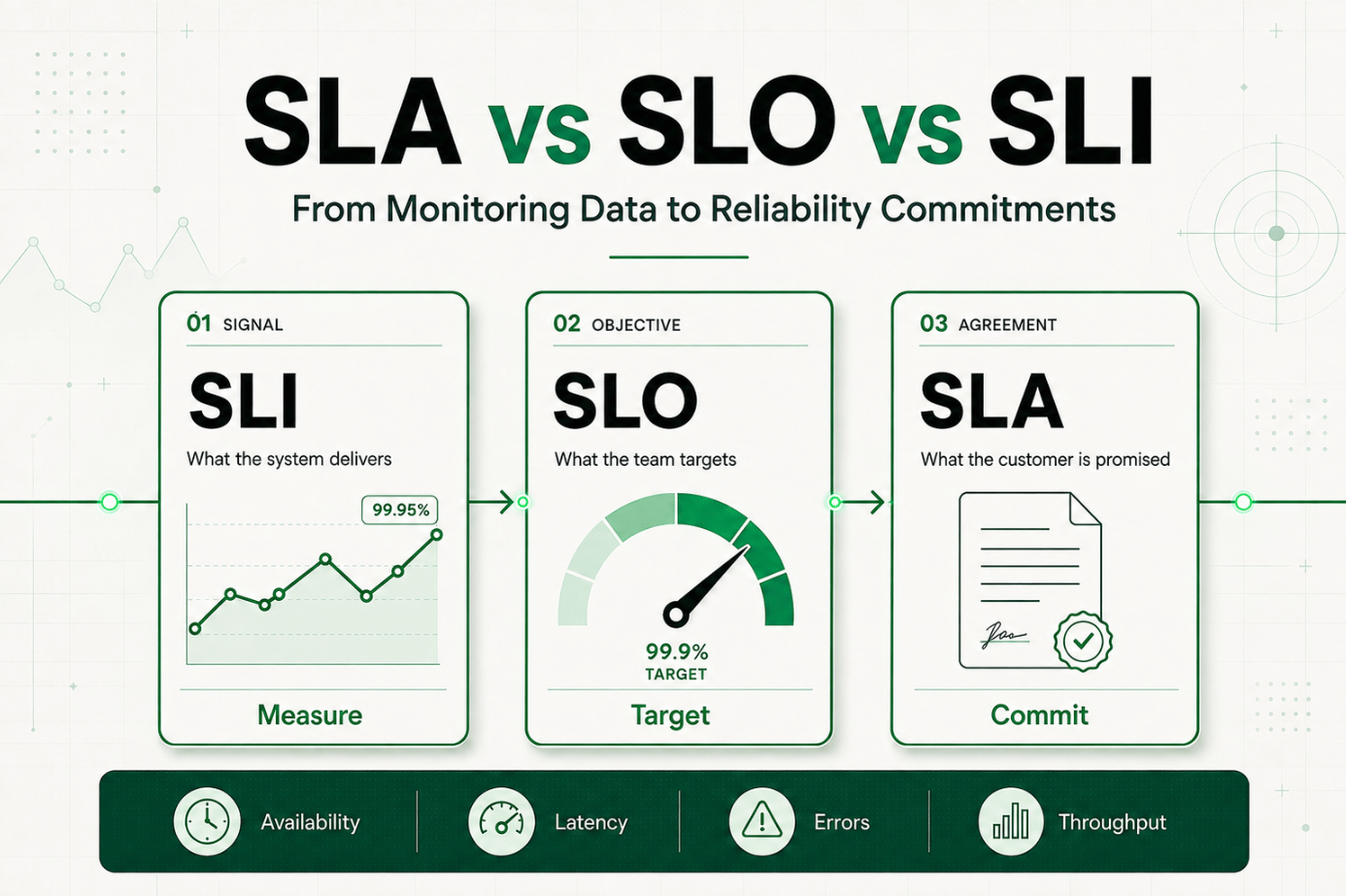
Reliability work only translates into trust when it's measured, targeted, and communicated consistently. A service level indicator is the raw measurement the actual data point, like the percentage of successful requests in the last five minutes. A service level objective is the internal target you're holding that indicator to, like "99.95% of requests succeed over a rolling 30 days." An SLA is the external commitment, often contractual, built on top of an SLO, usually with a bit of margin and real consequences attached if it's missed.
Getting this chain right matters because each layer serves a different audience and a different purpose. Engineers need SLIs to know what's actually happening right now. SRE and product teams need SLOs to know whether current performance is acceptable and how much risk-taking room remains. Customers and account teams need SLAs to know what's been promised and what happens if that promise is broken. When these layers are muddled when a team reports SLA style numbers without a clear SLI behind them, or sets an SLO without ever turning it into a customer facing SLA reliability reporting stops being trustworthy to whichever audience got the wrong layer.
The Operational Risk of Not Separating SLA, SLO, and SLI
Teams that use these terms loosely, without clear definitions and clear ownership of each layer, tend to run into a specific set of recurring problems:
- Reported uptime doesn't match customer experience. An SLI measured at the load balancer can show near perfect success rates while a specific customer facing feature checkout, search, a third party integration is degraded, because the indicator was never scoped to what actually matters to users.
- SLOs get set without any error budget discipline. A target of "99.9% uptime" means nothing operationally if no one is tracking how much of that allowed downtime has already been consumed, or when to freeze risky releases as the budget runs low.
- SLAs get signed that the underlying SLOs can't support. Sales or leadership commits to a customer facing SLA without confirming the internal SLO and the monitoring behind it is actually capable of meeting that number, creating a compliance gap that only shows up after a breach.
- No one can answer "are we actually reliable" with a single confident number. Without a clear chain from SLI to SLO to SLA, reliability conversations become anecdotal, mixing incident counts, gut feel, and cherry picked metrics instead of one accountable target and one enforced commitment.
Without a clearly defined error budget policy tying these layers together, teams typically discover the gap between promised and actual reliability the way most reliability gaps get discovered: during a renewal conversation, a churn risk review, or a service credit dispute, well after the underlying degradation happened.
How SLA vs SLO vs SLI Works: Key Signals, Thresholds, and Diagnosis
Service Level Indicator: What You're Actually Measuring
A service level indicator is a specific, quantifiable measurement of some aspect of service behavior request success rate, latency at a given percentile, throughput, or data durability. The most useful SLIs are measured as close to the actual user experience as possible, rather than at a layer, like the load balancer or the server, that might look healthy while the real user facing path is degraded.
Service Level Objective: The Internal Target
A service level objective is the target value for an SLI over a defined time window for example, "99.95% of checkout requests complete successfully, measured over a rolling 28 days." SLOs are internal facing by default, they exist so engineering and product teams have a concrete, shared definition of "good enough" that guides prioritization, incident response urgency, and release risk decisions.
Service Level Agreement: The External Commitment
An SLA takes an SLO and turns it into a formal, usually contractual, promise to a customer, typically with consequences service credits, termination rights attached to a miss. Published provider commitments, such as the AWS service level agreements, show how these promises are documented for individual services. SLAs are almost always set with margin below the internal SLO, since the SLA needs room for occasional target misses that don't breach the actual contract.
Error Budget Policy
An error budget policy operationalizes the gap between "100% reliable" and the SLO target. If the SLO is 99.9%, the error budget is the 0.1% of allowed unreliability over the measurement window. Tracking how much of that budget has been consumed and defining what happens when it's nearly gone, such as freezing non critical releases turns an SLO from an abstract number into an actual operating discipline.
Key Layers to Track
| Layer | What It Answers | Primary Audience |
|---|---|---|
| SLI (Service Level Indicator) | What is actually happening right now, measured directly | Engineers, on call responders |
| SLO (Service Level Objective) | What internal target are we holding ourselves to | SRE, product, engineering leadership |
| SLA (Service Level Agreement) | What have we promised externally, and what's the consequence of missing it | Customers, account teams, leadership |
| Error budget | How much allowed unreliability remains in the current window | SRE, release management |
| Reliability targets | The overall set of thresholds tying SLI performance to business risk | Engineering leadership, product |
Setting Thresholds
The most common threshold setting mistake is working top down only starting from a desired uptime SLA and reverse engineering an SLO without checking whether current SLI data can actually support it. A more reliable approach starts with historical SLI data: look at what the system has actually achieved over recent months, set an SLO with a realistic buffer above that baseline, and only then set an SLA with additional margin below the SLO. This ordering keeps commitments grounded in what's actually achievable rather than what sounds good in a sales conversation.
Diagnosis: Which Layer Is the Problem?
When a reliability conversation goes sideways a customer disputes an SLA credit, or an internal team disagrees about whether a quarter was "reliable" the fastest way to resolve it is checking which layer is actually in question. A dispute over what happened is an SLI question. A dispute over whether that was acceptable is an SLO question. A dispute over what was promised and whether it was met is an SLA question. Conflating these is usually why the conversation feels unresolvable in the first place.
A Practical Production Scenario
A B2B SaaS platform signs an enterprise customer with a 99.9% uptime SLA, backed by service credits for any month that falls below that threshold. Internally, the team has been tracking overall infrastructure uptime at the load balancer level, which has consistently shown 99.97% or better comfortably above the promised SLA.
Three months in, the customer flags repeated failures in a specific integration workflow that syncs data into their internal systems. The infrastructure level SLI shows nothing unusual, the load balancer and core API are healthy the entire time. But the integration endpoint specifically a narrower, less monitored path has been failing intermittently due to a downstream rate limit, well below the 99.9% threshold for that specific workflow, even though it never showed up in the broad infrastructure metric the team had been reporting against. Similar blind spots can be uncovered with database health endpoint monitoring, which checks whether critical application dependencies are actually responding as expected.
The gap here isn't a monitoring failure exactly it's an SLI scoping failure. The indicator being measured (general infrastructure uptime) didn't match the SLA's actual customer facing scope (this specific integration working reliably). Once the team defines a dedicated SLI for the integration endpoint itself, sets an SLO specific to it, and ties monitoring directly to that narrower, more representative measurement, the gap between "the dashboard looks fine" and "the customer is affected" closes.
Recommended Monitor Setup
- Define SLIs at the level of specific customer facing workflows, not just aggregate infrastructure health, especially for any workflow named explicitly in a customer SLA.
- Set SLOs with a real buffer above the corresponding SLA, based on historical SLI performance rather than an aspirational target.
- Track error budget consumption continuously, with an explicit policy for what changes (release freezes, added review) as the budget runs low.
- Alert on SLO burn rate, not just absolute SLI values, so a fast consuming budget triggers a response before the SLA itself is actually at risk.
- Review SLA relevant SLIs on a cadence that matches the contract's reporting period, so there are no surprises when a customer reviews the numbers.
Best Practices for Managing SLA, SLO, and SLI Together
Scope SLIs to Match What Customers Actually Experience
Measuring at the infrastructure layer alone often misses workflow specific degradation. SLIs tied to the actual customer journey login, checkout, a named integration produce a far more trustworthy signal than a general uptime number.
Set SLOs Before SLAs, Not the Other Way Around
Starting from historical SLI performance and setting an SLO with a realistic buffer, before ever committing to an external SLA, keeps commitments grounded in what the system has actually demonstrated rather than what a contract negotiation wants to promise.
Track Error Budget Consumption as an Operating Signal
An SLO without error budget tracking is just a number nobody's watching in real time. Treating budget consumption as an ongoing signal not just a quarterly retrospective metric lets teams react while there's still room to course correct.
Alert on Burn Rate, Not Just Point in Time SLI Values
A single bad SLI reading might be noise. A budget burning down quickly over a sustained window is a much stronger signal that the current SLO, and potentially the SLA behind it, is genuinely at risk.
Give Each Layer a Clear Owner
Engineering typically owns SLI accuracy and SLO target setting; account or product teams typically own SLA communication and customer facing reporting. Blurring this ownership is a common reason SLA commitments outpace what engineering actually knows is achievable.
Review and Recalibrate on a Regular Cadence
Reliability targets set once and never revisited tend to drift out of sync with actual system behavior as traffic, architecture, and dependencies change. A regular review keeps SLOs and SLAs honest against current reality.
Common Mistakes with SLA, SLO, and SLI
Mistake 1: Using the Three Terms Interchangeably
Why it happens: all three sound like they're measuring "reliability," so the distinction feels like semantics.
What to do instead: keep the definitions strict SLI is the measurement, SLO is the internal target, SLA is the external commitment and use each term precisely in reporting and conversation.
Mistake 2: Measuring SLIs Too Broadly
Why it happens: infrastructure level metrics are easier to instrument than workflow specific ones.
What to do instead: define SLIs at the level of the specific customer facing workflows named in your SLAs, not just aggregate system health.
Mistake 3: Setting SLAs Before Confirming the SLO Can Support Them
Why it happens: commercial pressure to promise a competitive number can outpace what engineering has actually validated.
What to do instead: set the SLO from real historical SLI data first, and only commit to an SLA with margin below that validated target.
Mistake 4: No Error Budget Policy Tied to the SLO
Why it happens: an SLO can exist as a reporting number without ever being connected to actual operating decisions.
What to do instead: define concrete actions release freezes, added review gates tied to specific levels of error budget consumption, so the SLO actually influences behavior.
Mistake 5: Alerting Only on Absolute Thresholds, Not Burn Rate
Why it happens: a single "SLI dropped below X" alert is simpler to configure than a rate of consumption alert.
What to do instead: alert when error budget is being consumed unusually fast, catching risk to the SLO before the absolute threshold is actually breached.
Mistake 6: No Clear Owner for SLA Communication
Why it happens: engineering owns the technical reliability work, and it's assumed SLA communication will simply follow from that.
What to do instead: explicitly assign SLA reporting and customer communication ownership, separate from SLI/SLO technical ownership, so external commitments stay accurate and timely.
Turn Your Monitoring Data Into Commitments You Can Actually Keep
Reliability reporting only builds trust when the SLI behind it is measured accurately, the SLO is grounded in real performance, and the SLA reflects what the system can genuinely support. Getting that chain right is what separates a dashboard that looks good from a commitment customers can actually count on. Explore more website monitoring and incident management guides to connect these reliability commitments with practical monitoring workflows.
Start a 30 day Statixoup beta and configure monitoring that ties SLI measurement, SLO tracking, and error budget alerts together, so your reliability targets and your customer commitments are finally telling the same story.